Draw foliage in a continuous line
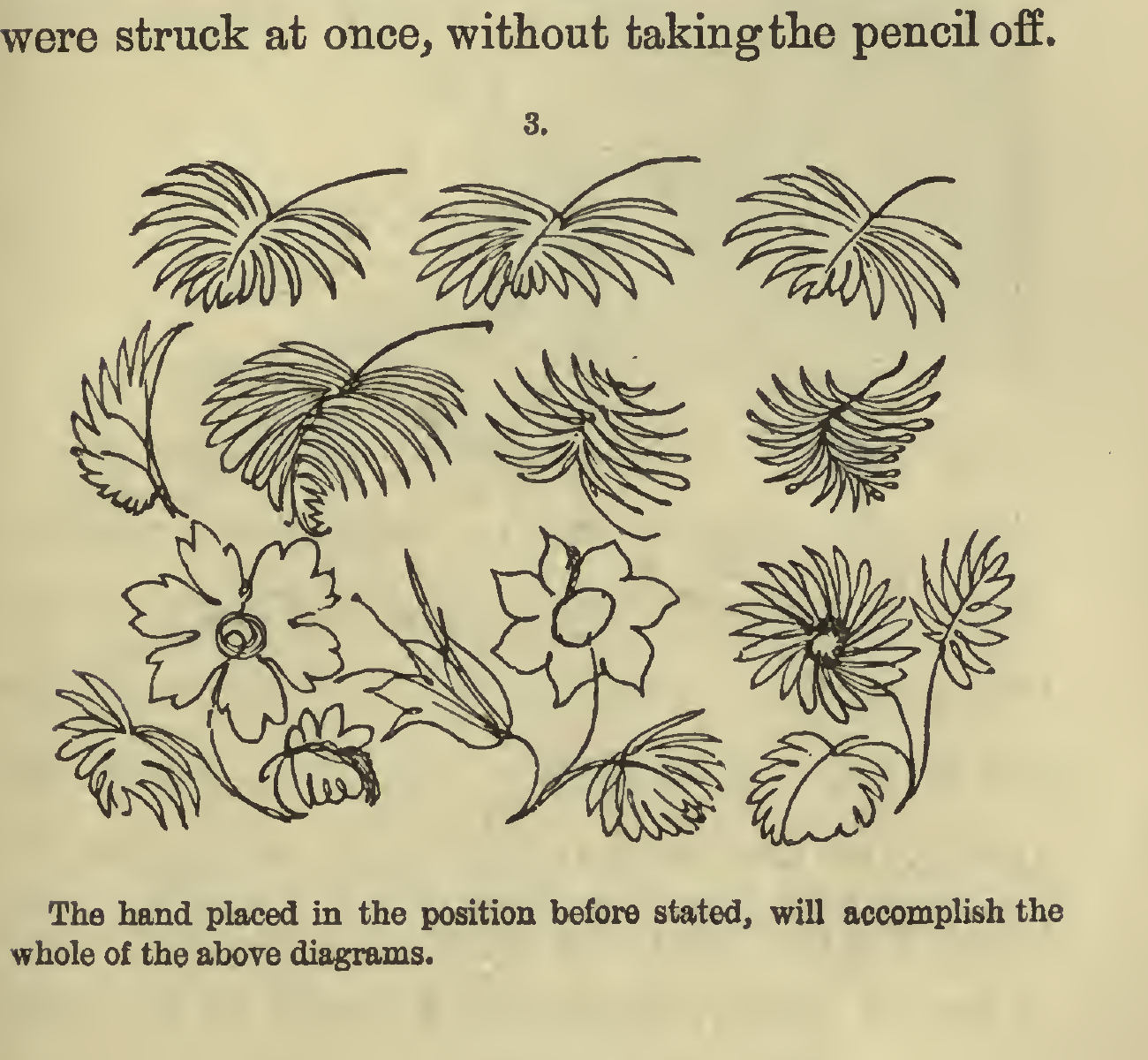
James Page’s drawing guide treats a steady hand as something developed through repeated curves. On printed pp. 22–25, he describes drawing an arc from a resting point and joining it to a concave curve; by p. 25, Fig. 3 gathers several leaf and flower-like forms into a single-line exercise. Page does not name the botanical species, so the forms are described here by shape rather than assigned plant names.
This is a drawing lesson, not a carving instruction. It differs from the measured leaf construction in Acanthus leaves and running scrolls: here the point is to keep a flowing pencil movement while varying the forms along it. Compare its use of a continuous border with illuminated initials and borders, then consider how ornament relates to the lettering field in planning an inscription before its frame.
Follow the curve
Section titled “Follow the curve”Page’s sequence starts with a broad arc. He describes using a point of rest for the arm, then extending the fingers to carry the curve into an adjoining concave line. He presents this as freehand practice for developing confidence in ornamental sketching; he also notes that similar curves can be made with a rule in architectural drawings. Fig. 3 demonstrates small variations of leaves and flower forms, with its accompanying text emphasizing that the diagrams were drawn without lifting the pencil.
Practice the rhythm
Section titled “Practice the rhythm”Try a present-day drawing exercise on scrap paper, using Page’s image as a historical prompt rather than a pattern to copy:
- Draw one broad, relaxed curve as the main direction of a small spray.
- In one continuous pencil movement, add a few short lobes or leaf-like turns along it.
- Repeat the exercise twice, changing the spacing and length of those turns while keeping the overall flow legible.
- Choose one study and adapt it as a small border or corner around a memorial inscription sketch. Leave clear space for the words; the ornament should support the reading order.
The memorial application and the exercise wording above are editorial adaptations, not procedures prescribed by Page. Page’s description of arm and wrist movement is historical source material, not current ergonomic or safety guidance. This article makes no recommendation about working posture or shop practice.
Source and editorial credit
Section titled “Source and editorial credit”James Page, Guide for Drawing the Acanthus, and Every Description of Ornamental Foliage, London: Bernard Quaritch, re-printed 1886. The title leaf prints “I. Page”; the Internet Archive catalog identifies James Page as creator. This article discusses printed pp. 22–25, corresponding to Archive PDF pp. 50–53; Fig. 3 is on printed p. 25 / PDF p. 53. The Archive item records possible status NOT_IN_COPYRIGHT for the United States only; this is item-level evidence, not a worldwide rights determination. See the Page source record.
The full source PDF remains in private review storage and is not bundled with the wiki. The linked PNG is a lossless crop from the 400 ppi page render; the smaller JPEG is a separate display derivative.