Let ornament follow the letters
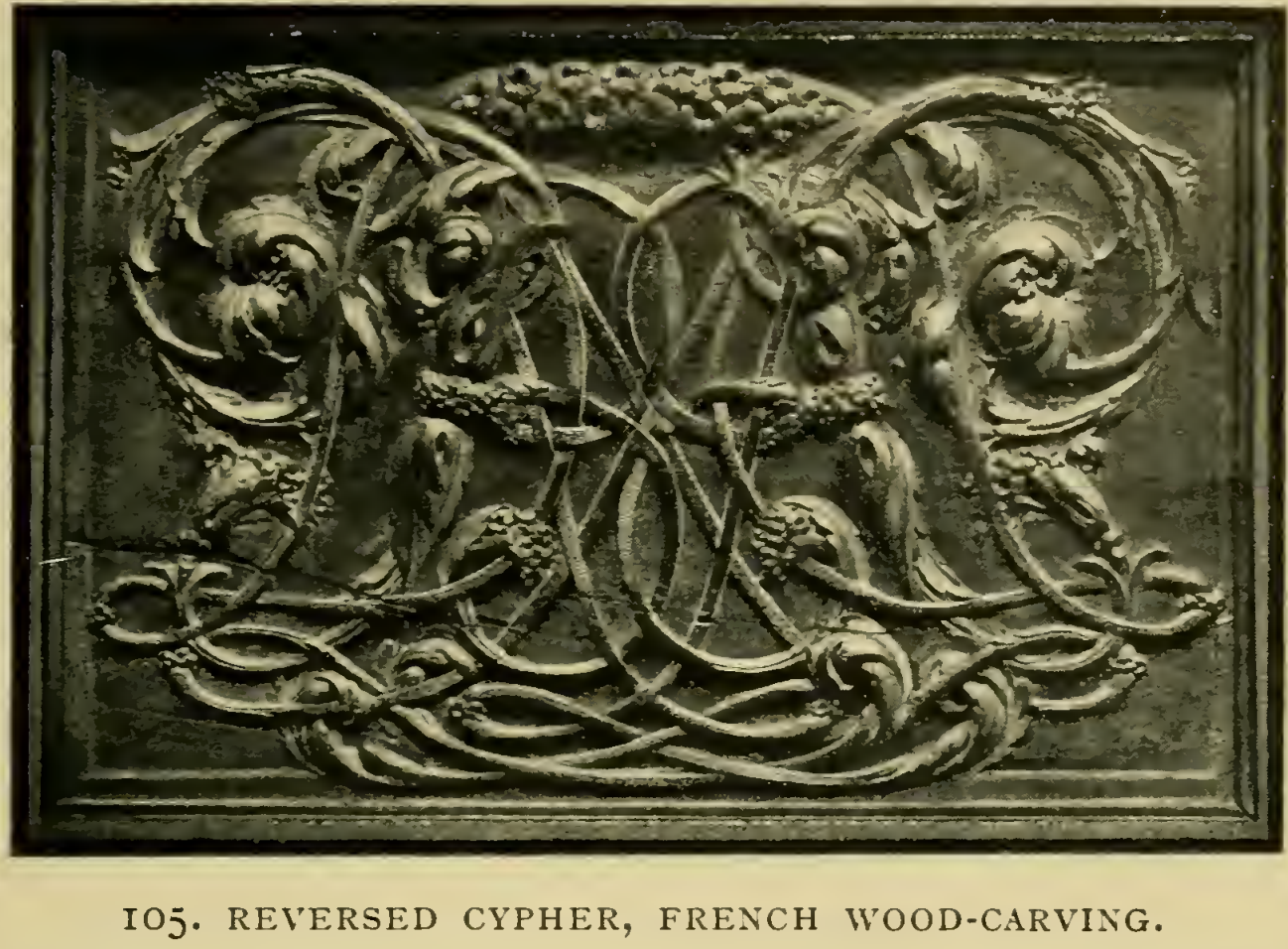
In Chapter X of Lettering in Ornament, Lewis Foreman Day distinguishes a cypher from a monogram. A cypher interlaces letters that remain complete and independent; a monogram combines parts of letters into one sign. His Fig. 105 shows a reversed cypher in French wood-carving. The lesson is about balancing ornamental pattern with readable initials, not reproducing a particular historic design.
Reversal can cost clarity
Section titled “Reversal can cost clarity”Day observes that designers sometimes reversed a sloping letter to make an arrangement symmetrical. That can produce a rich pattern, but it can also make the result obscure. He argues that symmetry is not essential: the lines need to make a good ornamental form. Small scrolls may balance a composition without turning a letter around, while an overworked search for symmetry can produce convoluted forms.
Try a modern paper study
Section titled “Try a modern paper study”This is a present-day sketching exercise informed by Day’s discussion, not a carving plan or a historical shop procedure:
- Write the initials in their intended reading order and draw each letter as a complete, separate form.
- Test one or two overlaps while keeping every letter identifiable from the same viewing direction.
- Make one balanced arrangement without reversing any letter. Use spacing or a small amount of secondary linework to balance the composition.
- Compare it with a symmetrical version. Ask a fresh reader to identify the initials without a hint; prefer the clearer arrangement even if it is less symmetrical.
Day’s Fig. 105 documents a historical example, not a universal solution. If interlacing hides the letters, keep the initials separate or use a restrained frame. For Day’s related distinction between combined monograms and independently complete letters, see Monograms and initials.
Source and image credit
Section titled “Source and image credit”Lewis Foreman Day, Lettering in Ornament: An Enquiry into the Decorative Use of Lettering, Past, Present, and Possible, Chapter X, “Cyphers,” opening at printed p. 129 (Archive PDF p. 165). Fig. 105 is captioned “Reversed cypher, French wood-carving.” The caption and descriptive list do not identify an individual carver or draughtsman; no separate maker is inferred. The title leaf names Day and publishers B. T. Batsford (London) and Charles Scribner’s Sons (New York), but is undated; the Smithsonian-contributed Archive item catalogs the edition as 1902. The item-level “No Copyright - United States” designation is U.S.-only evidence, not a worldwide rights determination. The PNG is a source-faithful crop of the exact page render; the JPEG is a display derivative. The full PDF remains in private review storage. See the Day source record.