Combine initials without losing their order
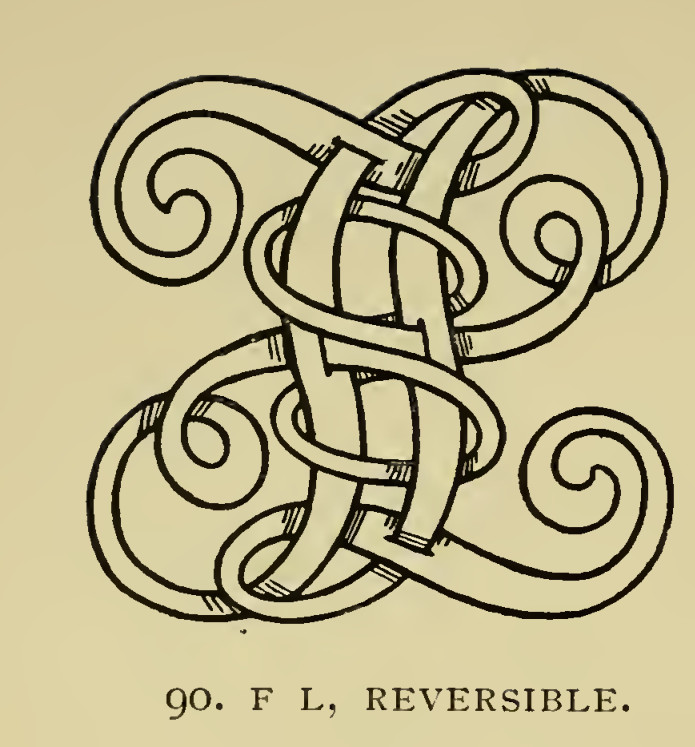
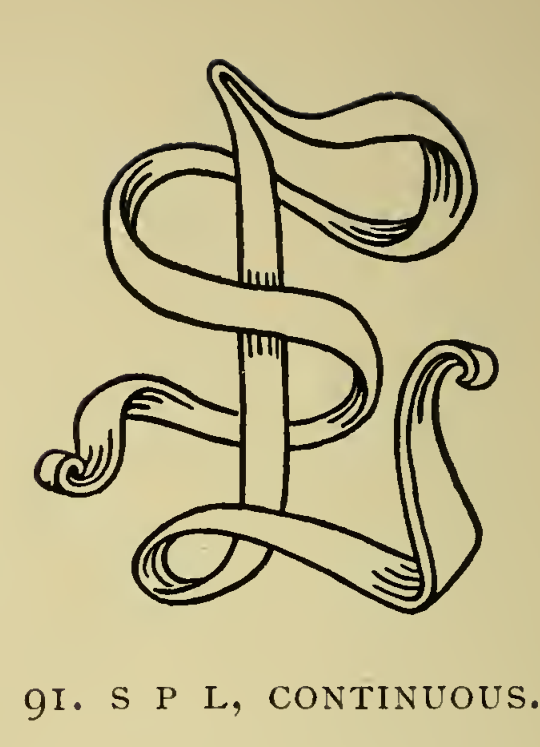
In Chapter IX of Lettering in Ornament, Lewis Foreman Day defines a monogram as two or more letters brought into one sign. His strict distinction matters: letters may be woven or interlaced into ornament while remaining independent; Day calls that kind of device a cypher. Figs. 90 and 91 show two different monogram possibilities, not templates for every name or memorial.
Join the letters, keep the reading path
Section titled “Join the letters, keep the reading path”Day’s examples make a useful design question visible: how can initials share a shape without becoming unreadable? He asks that their natural sequence remain apparent and their relative importance be maintained. A first initial may lead; a surname initial may deserve emphasis; or the initials may carry equal weight. The choice depends on the names represented, not on a universal hierarchy. The components should still read from the same viewpoint, with a coherent character and scale.
A monogram differs from letters that merely cross or loop around one another. In Day’s terminology, each component of a monogram takes part in the other letters. If every letter remains whole and independent, the interlacing may be decorative, but it is a cypher rather than a monogram. A continuous line alone does not settle the question: Day notes that a line can run continuously through a design even when its letters remain independently complete.
Try a present-day paper study
Section titled “Try a present-day paper study”This short exercise adapts Day’s historical design discussion; it is a modern sketching prompt, not a historical shop instruction or a carving specification:
- Write the exact initials and reading order for the name you have been asked to represent. Mark which, if any, should lead.
- Choose simple letterforms with a possible shared stroke, then draw each letter plainly before trying a combined outline.
- Make a few light variations in which a real part of one letter also helps form another. Keep their sequence and relative weight visible.
- View each sketch from one direction. Ask someone who has not been given the answer to identify the letters; if they cannot, simplify or use separate interlaced letters instead.
- Check that a frame does not supply legibility missing from the initials; treat it as a separate design decision.
The study uses Day’s criteria of sequence, balance and readability. His two historical examples demonstrate possibilities rather than a rule for all names. When the initials cannot become one legible sign, choose a different treatment rather than forcing a monogram. For the inscription around the initials, compare Day’s line-planning lesson.
Source and image credit
Section titled “Source and image credit”Lewis Foreman Day, Lettering in Ornament: An Enquiry into the Decorative Use of Lettering, Past, Present, and Possible, Chapter IX, “Monograms,” printed pp. 114-128 (Archive PDF pp. 150-164). Figures 90 and 91 are printed p. 118 / PDF p. 154; their captions read “F L, reversible” and “S P L, continuous.” The descriptive list on printed p. xviii / PDF p. 30 calls Fig. 90 a continuous monogram and credits it “by J. Bonella. (Barclay.)” It groups Figs. 91-92 as the continuous monograms “S. P. L. and G. P. L.” and credits the pair “by W. H. Rogers. (Barclay.)” The p. 118 image is Fig. 91, the S. P. L. example. Day’s discussion of natural sequence and relative importance continues on printed pp. 121-128 / PDF pp. 157-164. See the Day source record.
The scanned title leaf is undated; the exact Smithsonian-contributed Internet Archive item catalogs this edition as 1902. Its “No Copyright - United States” designation is item-specific U.S. evidence, not a worldwide rights determination. The PNG links are source-faithful crops from a 400 ppi page render; the separate JPEGs are display derivatives. The full PDF remains in private review storage.