Profiles and panels
A monument’s profile is built from edges, recesses, projections, and changes of finish. The 1919 dealer’s handbook drawing labels raised and sunken panels, a surface margin line, a band for a monogram or emblem, and several mouldings. Those marks show how the face was organized before lettering or ornament was considered. (DM PDF p.11; printed p.8)
The panel and its margin
Section titled “The panel and its margin”A panel creates a bounded field within the larger face of a die or base. The handbook distinguishes raised and sunken panels and labels a surface margin line beside rock-face work. It records a period drawing vocabulary; it does not prescribe one panel shape or proportion for all stones. (DM PDF p.11; printed p.8)
Inscription composition is a separate question: the lettering section covers how a block of words fits within its field. Here the subject is the stone around that field: where a recess begins, how much border remains, and how the face changes at its edge. (LM PDF pp.99-107.)
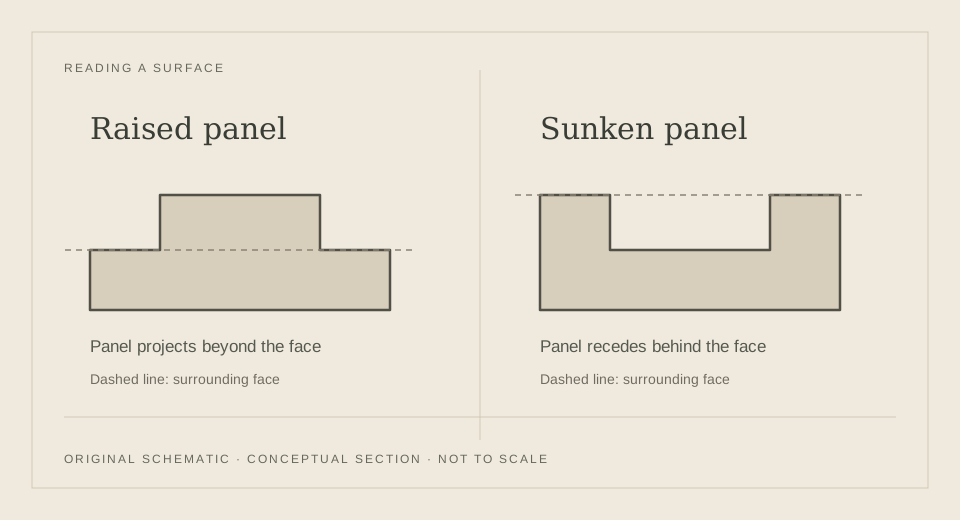
The same drawing labels forms such as bead, cyma, and ogee mouldings, along with grooves and a pediment. These profile names help distinguish a projecting edge from a recessed line. The page is a glossary and diagram rather than a modern construction standard. (DM PDF p.11; printed p.8)
Page’s drawing method for a moulded boundary
Section titled “Page’s drawing method for a moulded boundary”Page’s 1886 guide treats the profile as part of the ornament around it. He says the boundary of a running scroll should suit its character, then shows the difference between a profile read in section and a moulding worked into a decorated member. Figures 9 and 10 describe geometric guides for the cyma-recta and ogee. These are historical drawing examples, not dimensions for a stone or instructions for fabrication.
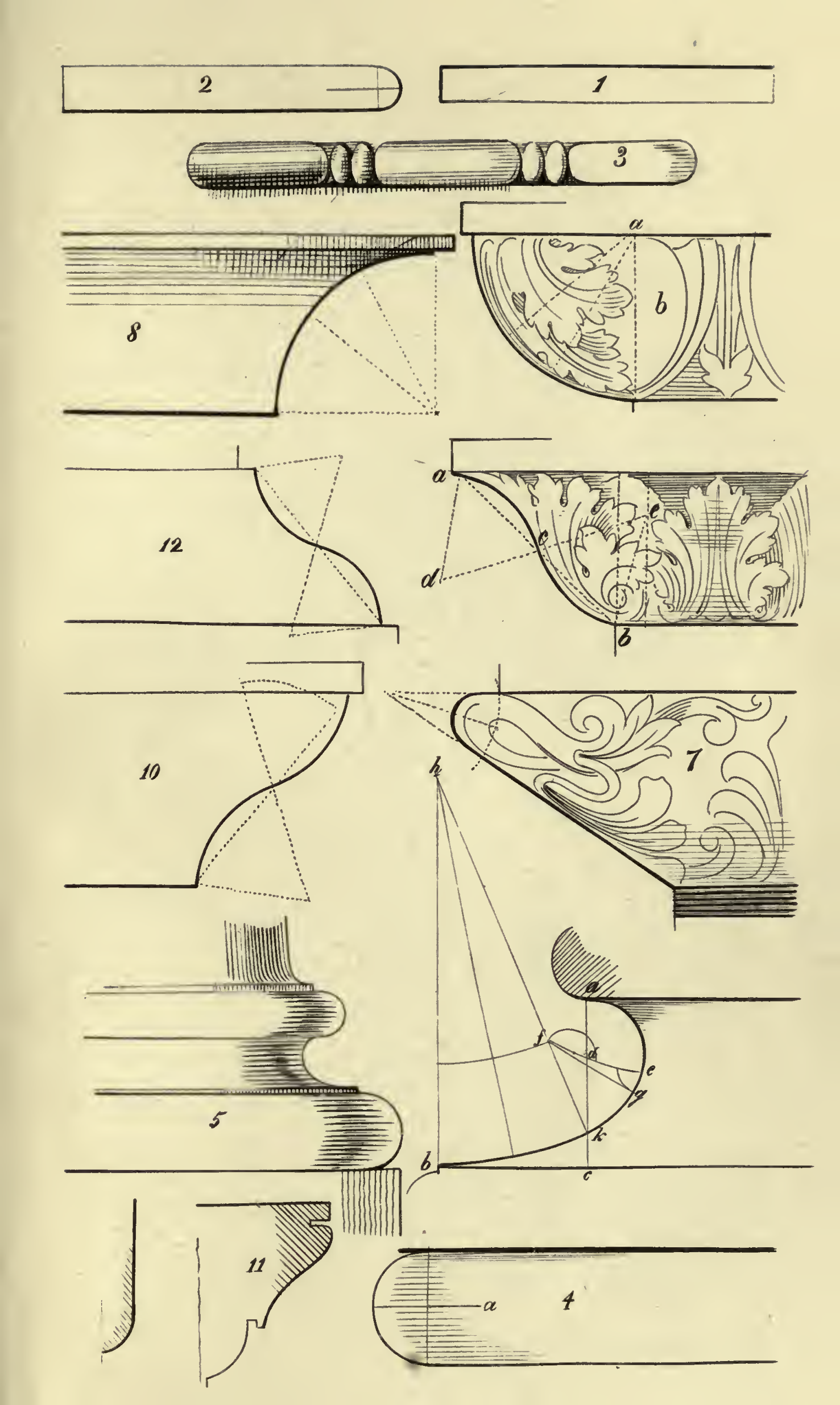
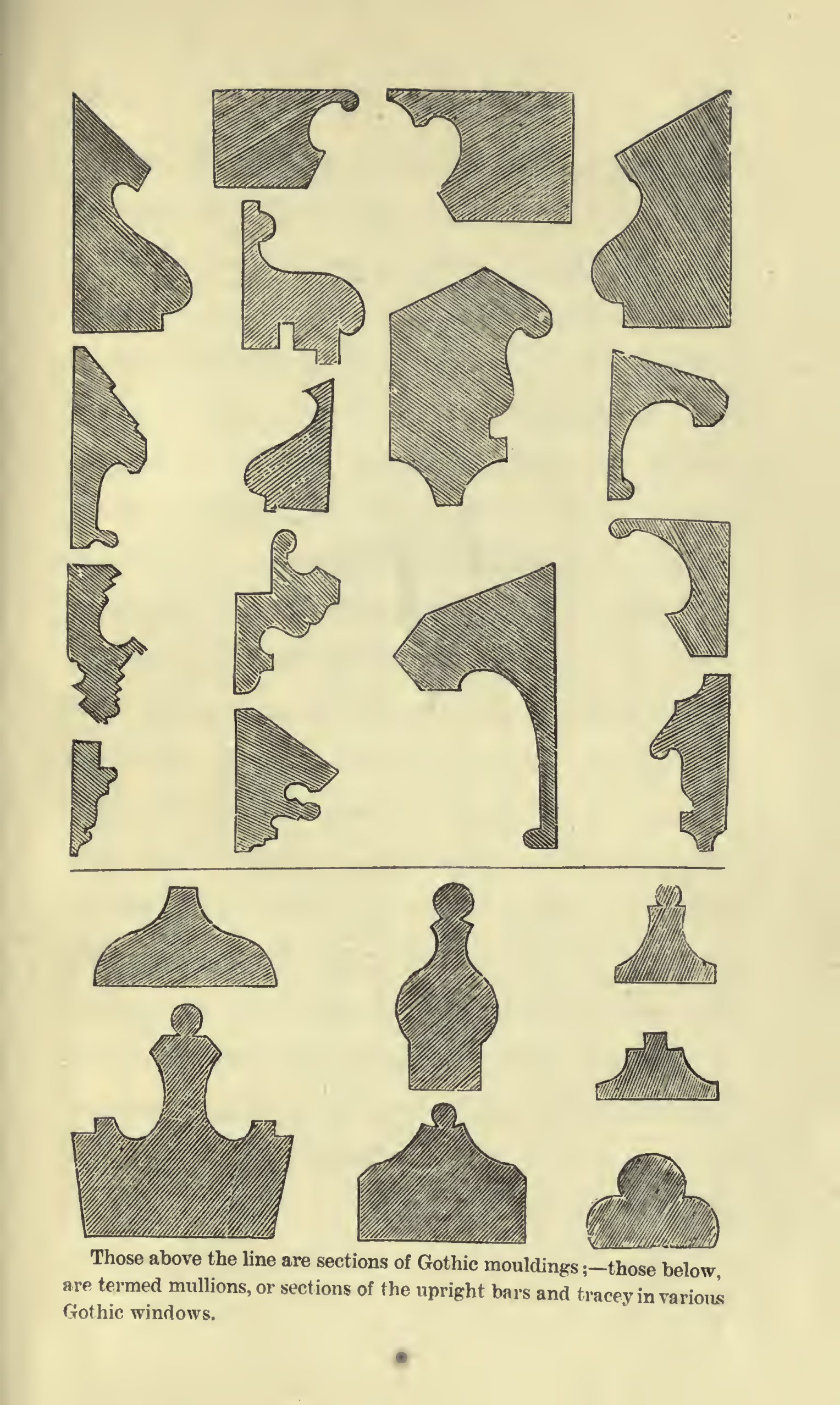
The second plate makes a useful distinction between moulded edges and the vertical members beside them. Page’s printed caption identifies the sections above its rule as Gothic mouldings and those below as mullions from Gothic windows. It is a drawing comparison, not a claim that every pointed memorial should use either form.
Try it in a present-day panel sketch
Section titled “Try it in a present-day panel sketch”As a modern paper exercise, draw the same blank memorial panel twice: give one a simple flat margin and the other a more shaped outline. Keep the inscription field unchanged, then compare how much attention the frame takes from the words. This is a visual study only; Page’s profiles do not set current stone dimensions, material choices, or construction methods. For a flat, repeated edge pattern, see geometric fret borders.
Page source and image credit
Section titled “Page source and image credit”James Page, Guide for Drawing the Acanthus, and Every Description of Ornamental Foliage, London: Bernard Quaritch, re-printed 1886. The title leaf prints “I. Page,” ornamental draftsman and designer; the preface says he undertook the work as author, engraver, and printer. The chapter “On Mouldings” begins on printed p. 239; the selected explanatory text is on printed pp. 240-242 / Archive PDF pp. 372, 375-376, with unnumbered plates at Archive PDF pp. 373 and 377. The plates name no separate draughtsmen. Archive item rights metadata is U.S.-only evidence and is not a worldwide determination. See the Page source record.
Smooth and rough surfaces
Section titled “Smooth and rough surfaces”The handbook’s diagram places a smooth margin beside a rock-faced field. Later contributors debate whether that contrast looks deliberate or artificial, and whether rough treatment suits a particular form. Their disagreement is useful evidence of period design taste, not a current finish recommendation. See rock-faced work. (DM PDF pp.11, 122-125; printed pp.8, 120-122)
See also
Section titled “See also”Sources
Section titled “Sources”- DM PDF pp.11-12, 122-125; printed pp.8-9, 120-122.
- LM PDF pp.99-107.