Historical trophy composition
In Chapter V, “On the Designing of Trophies,” James Page considers how a display is composed around a center and base. His examples range across military, naval, peace, arts, science, husbandry, music, and other themes. That list records one designer’s nineteenth-century vocabulary; it does not establish what a symbol means to a family today. (printed pp. 112–116; Archive PDF pp. 156–160)
Read the page as a historical drawing
Section titled “Read the page as a historical drawing”The unnumbered illustration on printed p. 116 gathers weapon forms into a dense, roughly balanced arrangement around a strong upright center. Page’s surrounding prose relates the image to his discussion of historical arms and imagined figures. The page supplies no standalone caption and names no separate draughtsman. Read the drawing as a period example of grouping, visual weight, and silhouette—not as advice to reproduce its weapons or symbolism.
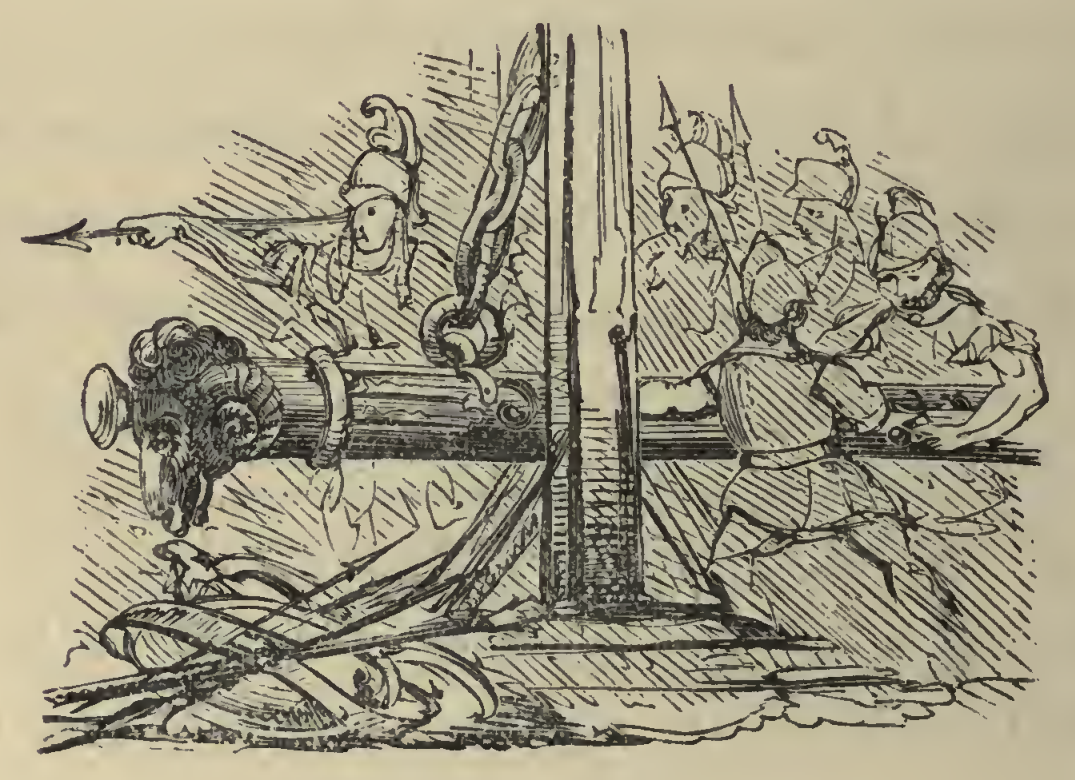
Page’s text repeatedly asks the reader to think about the overall form and the relationship between a prominent center and supporting elements. It also prescribes specific military and naval arrangements. Those prescriptions belong to the source’s period and are not current design, fabrication, or memorial recommendations. The examples do not document a named grave, family, or cemetery use.
A present-day paper study
Section titled “A present-day paper study”For a contemporary memorial sketch, begin with the wording and leave its field clear. If a family has chosen a documented emblem, draw that single emblem on a separate sheet and compare two quiet placements against the inscription. Check that the words remain the first thing a reader can find. This is a present-day visual exercise only; it does not specify stone dimensions, materials, carving, or installation. Confirm the chosen emblem’s meaning with the family rather than inferring it from Page’s historical examples.
Continue with the practical memorial-design reading path, or compare panel profiles, flat geometric borders, and leaf and scroll drawing.
Source and image credit
Section titled “Source and image credit”James Page, Guide for Drawing the Acanthus, and Every Description of Ornamental Foliage, London: Bernard Quaritch, re-printed 1886. The title leaf names “I. Page,” ornamental draftsman and designer; the preface says he undertook the work as author, engraver, and printer. No separate maker is named for this unnumbered illustration. Chapter V, “On the Designing of Trophies,” is printed pp. 112–116 / Archive PDF pp. 156–160; the selected illustration is printed p. 116 / PDF p. 160. Archive item rights metadata is U.S.-only evidence and is not a worldwide determination. See the Page source record.